Thursday, 5 March 2015

100s of Gulls Following Ploughs

Yesterday near Wooton the fields were being ploughed in preparation for sowing or planting a crop and that is attracting 100s of gulls and 10s of crows to feed on whatever invertebrates are being turned up.

Meanwhile near the route of the former Uttoxeter Canal Dog's Mercury is starting to flower.

Saturday, 21 February 2015

Early spring flowers and a familiar fungi.

Walking along the Caldon Canal between Froghall and Consall yesterday we spotted early spring flowers and a fungi.

Female flowers of Butterbur. A native species which supplies a good source of pollen and nectar for early flying insects. Later in the year the, sometimes very extensive, patches of large leaves this plant produces can smother out other plants as does the reviled non-native Himalayan Balsam. 

Elf Cup Fungi . There are two very similar species of this particular fungi Sarcoscypha austriaca and S. coccinea and I don't know which one this is. Its easy to spot if you look for dead branches on the woodland floor as its bright red colour stands out in contrast to the green of moss and other leaves.

Opposite-leaved Golden Saxifrage grows in damp, shady places. It is an evergreen plant so its leaves are present all year round. You have to look hard for the yellow, star-like flowers as they are only a few mm across; they are just starting to appear this week. 

This photo of Wild Garlic was taken in a previous year - it isn't actually in flower just yet. However the new leaves of this species are just beginning to poke through the dried up remains of last year's autumn leaves. They are safe enough to eat as long as you pick some from a place where a dog in unlikely to have peed on them. Our hunter-gatherer ancestors must have welcomed the appearance of this plant coming back after the winter months as it was presumably one of the first fresh things they got to eat. 

Monday, 19 January 2015

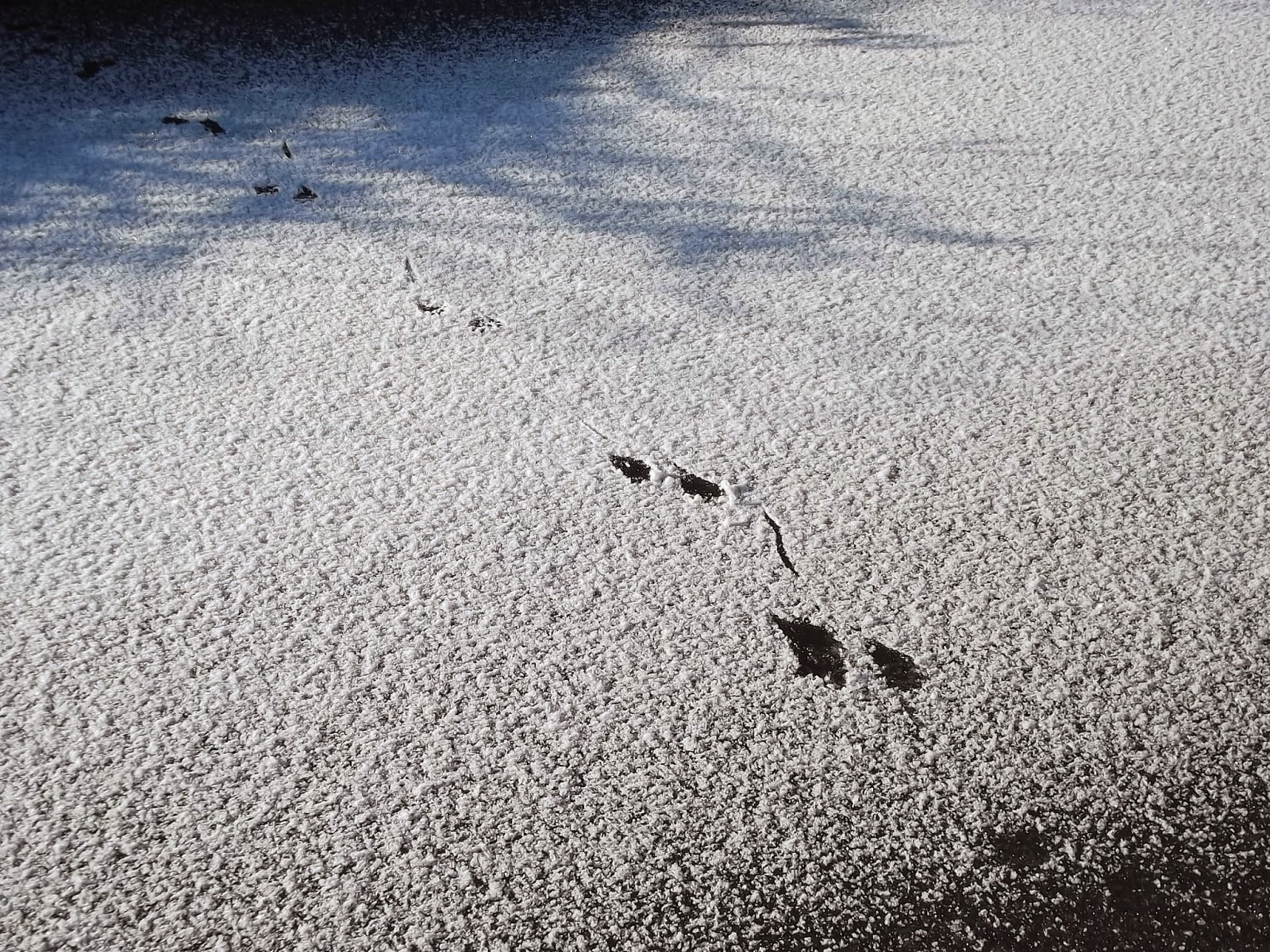
Footprints in the snow.

Yesterday was a good day to go out to look for sign of mammals. Here are prints of five species (fox, otter, rabbit, grey squirrel and a badger prints plus sett) photographed in the Churnet Valley.

Fox.

Fox.

Otter.

Otter 

Rabbit back paws.

Rabbit front paws. 

Grey Squirrel 


Badger beeding trail across footpath.

Badger footprint

Wednesday, 14 January 2015

Churnet Valley Wildlife January 2015

Three herons in December.

December was a good month for me to spot different species of heron in the Churnet Valley area.

On 23rd of the month I saw a Little Egret for the first time at Stanley Pool (not strictly speaking in the Churnet Valley but close being about 2km from the boundary of the Churnet Valley Living Landscape (CVLLP) area.

Little Egret on Stanley Pool.


Then on Christmas Day, whilst walking on a public footpath between The Roaches and Goldsitch Moss me and my husband nearly stepped on a Bittern which had been sitting in a patch of rushes near a stream that runs alongside the path. It flew up in front of us and we got a very clear view of its lovely plumage.

Three days later (28th December) during a walk along the Caldon Canal between Froghall and Consall I watched a Grey Heron wrestling with a small mammal. I could not tell what species it was, but I watched as the unfortunate creature struggled to free itself from the heron's beak! It didn't succeed.

Grey Herons are, of course, commonly observed in suitable habitat pretty well all over the British Isles, however the other two heron species are not so often seen. Bitterns were once extinct in the British Isles, their demise being due to habitat damage and human persecution. Then, following concerted work to improve certain areas for Bitterns they have now started breeding here once again, mostly on nature reserves. Britain also hosts an influx of overwintering Bitterns from mainland Europe, and I expect the bird we saw was one of these (there had been sightings of a Bittern on the nearby Tittesworth Reservoir about the same time and maybe this was the same bird). The Little Egret is a more recent colonist, first breeding in the south of Britain in the late 1990s. The British Isles are its most northerly breeding area and, with the advent of a warming climate, their numbers and range are expected to expand.

Dipper and Blackcap.

I was pleased to spot a Dipper in Deep Hayes Country Park on 11th January. These birds need unpolluted streams and rivers (i.e. not enriched with nutrients and not acid) in order for there t be sufficient invertebrate prey. So this bird, which was the first I have ever spotted in that location, was a sign that the stream through the nature reserve is in relatively good condition.

Dipper.

Mike Tunnicliffe of Alton has had a Blackcap visiting his garden feeders. Accoring to the BTO's Bird Atlas 2007 – 11 the incidence of Blackcaps visiting gardens during winter peaks in late January to February, so Mike's observations seem to fit this trend. Up until the 1990s Blackcaps were considered to be summer visitors to the British Isles, just coming here to breed and then returning to their southern European and W. African home for the winter period. Then in the 1990s it was noticed that some birds were overwintering here too. Genetic studies showed that these birds were actually from breeding populations central Europe that had developed the habit of overwintering in Britain as our climate warms and is thereby more able to provide food for these birds during the harsh weather. As the spring arrives these birds will return to Europe to breed and will be replaced by birds from France, Spain and W. Africa.

 Female Blackcap by Terry Eyre.

Brookleys lake

Brookleys Lake is the largest of a series of pools which to me look as if they have been artificially created by widening sections of a tributary of the Churnet, perhaps for industrial or amenity purposes. There is a former sand quarry near by and I wonder if the largest pool (Brookleys Lake) was a site of sand extraction (if anyone knows more about this I would be pleased if they will let me know). The water bodies are relatively large having a surface area of about 5km, making them in total less than half the size of Rudyard and Tittesworth Lakes. They are located between Wooton and Alton and are near Farley Hall. In fact the tributary passes through the grounds of Wooton Park where it is widened to form Canada Lake. I think this location may be significant because the lake appears to be an important overwintering site for certain ducks. For instance on 24th December 2014 I saw about 50 Mandarin and 200+ Mallards on the lake. I suspect this is the stronghold for mandarins in the Churnet Valley area and I think these birds may be the descendants of birds acquired for the grounds of the big houses (Alton Towers, Wooton Lodge and Farley Hall) in the 17th or 18th century. Brankleys lake and Wooton Park and Lodge are owned by JCB however there is a public footpath passing by the lake and through the edge of the private grounds of Wooton Lodge. It is worth a look to wee the large flock of Mandarin ducks, and who knows what else you might see?

Brookleys Lake  near Alton.


Here is a lovely series of short nature programmes on BBC Radio 4http://www.bbc.co.uk/programmes/b04xnczz. It is Brett Westwood talking about his birding diary which he started when he was 15 years old. It will be available on the BBC iPlayer until the start of February so you can listen to it there should you want. 

Tuesday, 30 December 2014

Birds seen in Churnet Valley December 2014


This photo of Black-headed Gulls on a frozen seasonal pool near Cheddleton wa taken on 28th december 2014. Sometimes Oystercatchers are seen at this pool,but on that day there were none. However there was a flock of about 14 Snipe feeding and flying in the area, plus various tits, finches etc. Earlier in the day a flock of about 100 Pink-footed Geese flew from the Staffordshire Moorlands area towards S-O-T. Below is a list of birds seen (by me (Wendy Birks) in the Churnet Valley this month. 

A "1" indicates species present (not numer seen) DHCP = Deep Hayes Country Park and H. Junct. = Hazelhurst Junction. If no "1" or comment then the species was not seen. The Bittern was  a surprise sighting on the edge of the Roaches Estate. During a walk on a foggy and frosty Christmas day It flew up from a rushy patch as we walked along a public footpath adjacent to a stream. A Bittern had also been a recent visitor to nearby Tittesworth Reservoir and I think that this may the same one that had become disorientated whilst flying in the fog and was sheltering by the most readily available waterside habitat.


2014 December

Barn owl Kingsley Marsh Tit DHCP
Bittern The Roaches Estate Meadow Pipit near Hazlehurst Junction
Black-headed gull 1 Merlin
Blackbird 1 Mistle Thrush 1
Blackcap
Moorhen 1
Blue tit 1 Mute swan 2 Brookley's Lake
Brambling
Nuthatch 1
Bullfinch 1 Oystercatcher
Buzzard 1 Peregrine
Canada Goose 1 Pheasant 1
Carrion Crow 1 Pied Flycatcher
Chaffinch 1 Pied Wagtail 1
Chiff Chaff
Pink-Footed Goose flock flew from Staffs Moorlands along Endon valley towards S-O-T
Coal Tit 1 Pochard
Collared Dove 1 Raven 1
Common Gull
Red Grouse Roaches
Common Sandpiper
Red Kite
Coot 1 Red-legged Partridge
Cormorant Rudyard Lake Redshank
Crossbill
Redstart
Cuckoo
Redwing 1
Curlew 1 Reed Bunting H. Junct.+ Chedd.
Dipper 2 Cotton Dell Reed Warbler
Dunlin
Ringed Plover (Little)
Dunnock 1 Ring Ouzel
Fieldfare flocks in many places Robin 1
Gadwall 1 Brookleys Lake Rock dove/feral pigeon 1
Garden Warbler
Rook 1
Garganey
Sand Martin
Goldcrest 1 Sedge Warbler
Goldeneye
Short-eared Owl
Goldfinch 1 Shoveler
Goosander Rudyard Lake and Whiston Quarry Siskin H.Junct. & Froghall
Goshawk
Skylark
Grasshopper Warbler
Snipe near H.Junct. + near Chedd
Great black backed Gull
Song Thrush 1
Great Crested Grebe Rudyard Lake Sparrowhawk 1
Great Spotted Woodpecker 1 Spotted Flycatcher
Great Tit 1 Starling 1
Green Woodpecker H. Junct. Stock Dove
Greenfinch 1 Stonechat
Grey Heron 1 Swallow
Grey Partridge
Swift
Grey Wagtail 1 Tawny Owl 1
Greylag Goose
Teal DHCP
Herring Gull
Tree Creeper 1
Hobby
Tree Pipit
House Martin
Tree Sparrow 1
House Sparrow 1 Tufted Duck 6 DHCP
Jackdaw 1 Water Rail
Jay 1 Waxwing
Kestrel 1 Wheatear
Kingfisher Caldon Canal near Longsdon and DHCP Whitethroat
Lapwing 1 Wigeon 12 H. Junct.
Lesser black backed Gull H. Junct. Willow Tit DHCP
Lesser Redpoll
Willow Warbler
Lesser Spotted Woodpecker
Woodpigeon 1
Lesser Whitethroat
Wood Warbler
Linnet
Woodcock
Little Grebe 1 DHCP & 1 Brankley Lakel Wren 1
Little Owl near Rudyard Lake + Kingsley Yellow Wagtail
Long-eared Owl
Yellowhammer
Long-tailed Tit 1 Little Egret
Magpie 1 Greater Scaup
Mallard 1 Lesser Scaup
Mandarin Duck DHCP 2 pairs c50 Brookleys Lake Common Tern


Hen Harrier


Turtle Dove

Wednesday, 24 December 2014

Mandarins and Mallards at Brookleys Lake today

I counted at least 200 Mallards and about 50 Mandarin Ducks at Brankley pool today.


Three photos of bracket fungi on a dead trunk near froghall.


A winter apple tree near in tussocky grassland near Crumpwood Weir. 


And....it was warm enough for, at least some, insects to fly.


Tuesday, 16 December 2014

Birds and mammals spotted at Deep Hayes Country Park December 2014.


Deep Hayes Country Park 13/12/2014 and 16/12/2014 Notes
Mallard About 40 16 on middle pool 20 on bottom pool
Tufted Duck About 5 males and females
Mandarin Duck 2 pairs
Tufted Duck About 5 males and females
Goosander About 7 males and females
Coot 7
Moorhen About 6
Little Grebe 1


possible Water Rail
skulking near reedmace bed
Kingfisher 1 briefly perched in tree by little pool by bird hide
Buzzard 1 flying over


Pheasant 1
Goldcrest 1
Dunnock 1
Chaffinch 3 from bird hide
Wren 13 plus3 heard
Blackbird 21 plus
Coal Tit 3 plus from bird hide
Long -Tailed Tit About 8 from bird hide first day and in tree tops second day
Blue Tit 22 plus
Great Tit 6 plus
Willow Tit (possible) 1 feeding in front of bird hide
Marsh Tit 1
Robin 5 plus
Nuthatch 5 plus
Woodpigeon 4
Great Spotted Woodpecker 1
Jackdaw About 18
Jay 1
Carrion Crow 2
Fieldfare 3


At least 30 bird species.


Grey Squirrels 4 feeding in front of bird hide plus more in woodland
Red Fox
attempted to catch bird feeding in front of bird hide first day and another (perhaps same one ) seen second day